

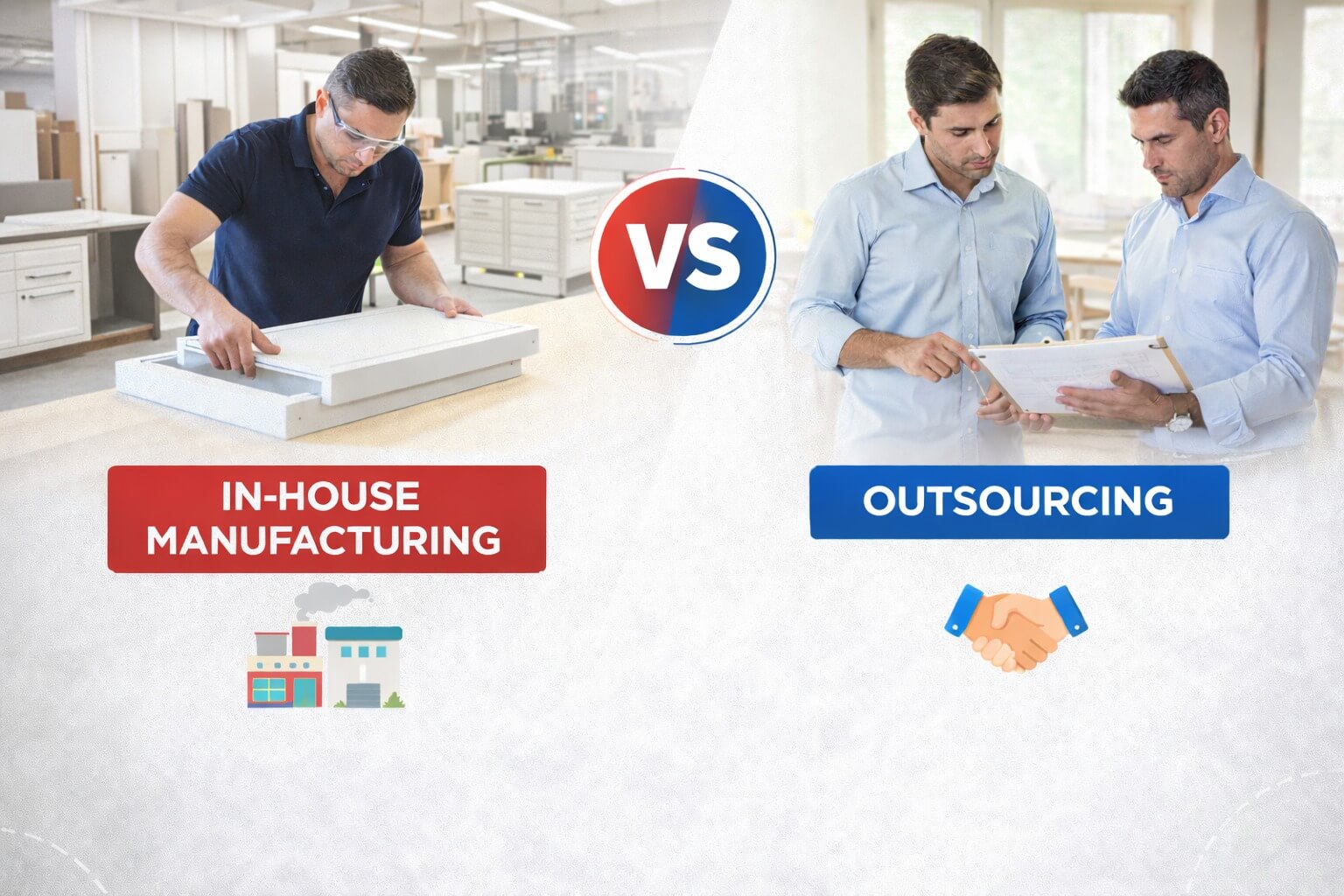
When planning a home interior project, many homeowners focus on design visuals and pricing but overlook the production process. But the choice of whether to opt for in-house manufacturing vs outsourcing directly affects quality, timelines, costs, and long-term satisfaction.
In interior projects, delays, uneven finishes, and unclear accountability often come from how work is executed, not just how it is designed.
What Is In-House Manufacturing in Interior Design?
In-house manufacturing means the interior brand handles designing, producing, and installing your furniture using its own factory and team. The same company that creates your interior designs also manufactures and installs the furniture, without involving outside vendors. After design finalisation, the approved plans move to the factory for production. Once complete, the units are transported and installed on-site by the same team.
This streamlined approach reduces errors, eliminates confusion, and ensures strong quality control at every stage. Common examples of in-house manufacturing include wardrobes, storage units, custom-made furniture, and a factory-made modular kitchen, where cabinets are produced in a controlled factory environment instead of being built on-site.
A Comparison of In-House vs Outsourcing
A quick comparison helps you see the main differences in quality, cost, and control when choosing an in-house factory vs. outsourcing for your home interiors.
| Factor | In-House Manufacturing | Outsourcing |
| Quality control | Centralised and consistent | Depends on vendors |
| Timeline | Planned and predictable | Often delayed |
| Cost transparency | Clear and itemised | Costs may change |
| Material consistency | Same materials throughout | Materials may vary |
| Finish & precision | High factory accuracy | Depends on workmanship |
| Accountability | Single point responsibility | Split among vendors |
| Design flexibility | Better execution accuracy | Design may change |
| After-service support | Structured and reliable | Limited or unclear |
Key Benefits of In-House Manufacturing
In-house manufacturing offers clear, practical advantages that directly impact the quality, speed, and reliability of your interior project.
Better Quality Control at Every Stage
In-house systems allow brands to closely monitor raw materials, cutting, finishing, and final assembly. This ensures consistent standards and dependable output, which is essential for precision furniture manufacturing.
Precise Measurements & Factory Finish
Factory production uses machines instead of manual tools, ensuring exact measurements and uniform finishes. This results in smooth edges, proper alignment, and a clean factory finish modular kitchen or wardrobe that fits perfectly.
Faster Delivery With Fewer Delays
Since production happens internally, scheduling is controlled. There is no dependency on external vendors, which reduces waiting time and avoids unexpected pauses.
Transparent Pricing With Fewer Hidden Costs
In-house manufacturing removes multiple mark-ups. Pricing remains clear because one company manages materials, labour, and installation. This transparency is often missing when comparing an interior factory vs contractor, where costs may change during execution.
Better Coordination Between Design and Execution
Design teams work closely with factory teams, making communication faster and clearer. If any design change is required, it is implemented quickly, reducing errors, rework, and on-site confusion.
When Outsourcing Can Work Well
Outsourcing is not always a poor choice. It can work well in limited situations where the scope is small, timelines are flexible, and high precision or long-term durability is not a major requirement.
Small, Low-Budget Projects
Outsourcing can suit small projects with limited budgets, such as basic furniture or temporary setups. It helps control costs when the work does not require high detailing or long-term performance.
Quick Carpentry-Only Requirements
For simple carpentry work like shelves, cabinets, or minor wood additions, outsourcing to local carpenters can be sufficient. These tasks usually need quick execution rather than detailed factory-level precision.
Simple Repairs or Basic Upgrades
Outsourcing works for small repairs or basic upgrades where durability and finish are not critical. Such work includes fixing panels, replacing hinges, or making small functional changes.
The Hidden Risks of Outsourced Interior Execution
Outsourced interior work may look flexible at first, but it often brings hidden risks that affect timelines, quality, and costs. These issues usually appear during execution and can create stress for homeowners.
Delays Due to Vendor Dependency
Outsourced projects depend on multiple vendors working together. If even one vendor is delayed, the entire schedule gets affected. Designers have limited control over external teams and cannot always prevent timeline slippage.
Inconsistent Materials and Finishes
Different vendors often use different materials, boards, finishes, and hardware. This leads to uneven quality across rooms. The final result may look mismatched and lack the uniform finish expected in a complete home interior.
Multiple Teams
When many teams are involved, responsibility becomes unclear. If problems arise, designers blame vendors and vendors blame site conditions. This confusion delays solutions and leaves homeowners stuck managing the situation themselves.
Cost Changes Midway
Outsourced projects often face price changes after work begins. Extra labour, material upgrades, or design revisions increase costs. These additions may not be planned earlier, causing budget stress for homeowners.
Limited Warranty and After-Install Support
Outsourced interiors usually offer limited warranty and weak service support. After installation, follow-ups become difficult. There is no single team responsible for long-term maintenance or issue resolution.
Which One Should You Choose for Your Home?
At this stage, many homeowners start comparing which is better in house or outsourcing, and the right choice depends on what you expect from your interior project. Factors like finish quality, timeline control, budget clarity, and long-term support play a major role in making this decision.
Choose In-House Manufacturing if,
- You want a premium finish and furniture that stays strong, functional, and good-looking for many years without frequent repairs or replacements.
- You expect clear and predictable timelines, with proper planning and minimal chances of delays during manufacturing or installation.
- You prefer single-point responsibility, where one company handles design, production, installation, and post-install service without passing blame.
- You are investing in a full home interior setup, such as kitchens, wardrobes, and storage units, where consistency, quality, and coordination are important
Choose Outsourcing if,
- You are handling basic, low-risk interior work with limited finish expectations
- You have enough time to coordinate and manage multiple vendors independently
- You are comfortable supervising daily site execution and resolving issues personally
Questions to Ask Before You Finalise Any Interior Partner
Before choosing any interior partner, asking the right questions helps you understand their process, responsibility, and long-term commitment.
- Who manufactures the furniture?
- Do you have your own factory?
- What material brands do you use?
- What is the timeline commitment?
- What is included in the quote?
- What warranty do you provide?
- Who handles installation and service?
Final Verdict: In-House Manufacturing vs Outsourcing
In-house manufacturing offers better control, consistency, and accountability for home interiors. It reduces stress, improves quality, and ensures smoother execution from start to finish.
For homeowners seeking long-term value, reliable timelines, and professional execution, choosing a partner with strong manufacturing capabilities builds trust and delivers peace of mind.
FAQs
Is in-house manufacturing more expensive than outsourcing?
Not always. While the initial quote may seem higher, it often includes better materials, warranty, and fewer revisions, making it cost-effective long term.
What is the biggest advantage of in-house interiors?
Better control over quality, timelines, and accountability under one system.
Does outsourcing reduce quality?
Quality can vary depending on vendors. Without strict supervision, consistency often suffers.
Which option delivers faster completion?
Projects managed under one internal system usually finish faster due to better coordination.
Is factory-made furniture better than site carpentry?
Factory-made furniture offers better finish, accuracy, and durability due to machine precision.
What works best for kitchens—factory production or vendor execution?
Factory production ensures better alignment, finish, and long-term performance for kitchens.